

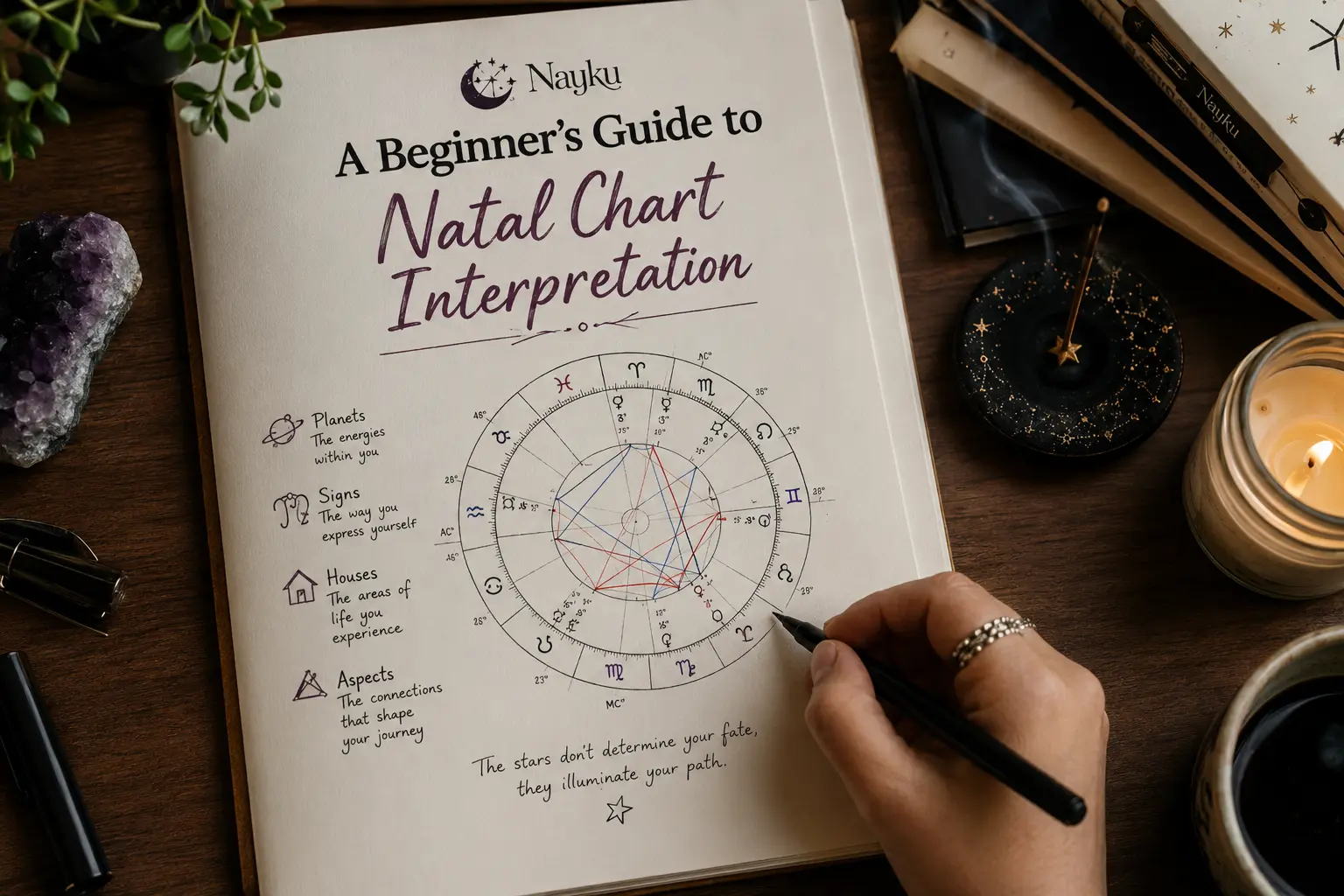
Learn how to read your birth chart step by step. Discover the meaning of planets, houses, zodiac signs, and aspects in astrology. A complete beginner's guide to understanding your natal chart.
How to Read Your Birth Chart: A Beginner’s Guide
Introduction
If you’ve ever read your daily horoscope and wondered whether astrology has more to offer than a simple Sun sign prediction, you’re not alone. For many people, astrology begins with curiosity and quickly develops into a deeper journey of self-discovery. At the heart of this journey lies the birth chart, also known as the natal chart—a personalized map of the heavens at the exact moment you were born.
Unlike generic horoscope readings that categorize millions of people under one zodiac sign, a birth chart is uniquely yours. It captures the positions of the Sun, Moon, planets, and other astrological points based on your date, time, and place of birth. Astrologers believe that these placements reveal important insights about your personality, emotional patterns, strengths, challenges, relationships, career tendencies, and life purpose.
For beginners, a birth chart can look overwhelming. The circular diagram is filled with symbols, numbers, lines, and unfamiliar terminology. However, learning to read a birth chart is much like learning a new language. Once you understand the basic components and how they work together, the chart begins to tell a fascinating story about who you are and how you experience the world.
This guide will walk you through the foundations of birth chart interpretation, helping you understand planets, zodiac signs, houses, and aspects in a way that is practical and easy to follow.
What Is a Birth Chart?
A birth chart is an astrological snapshot of the sky at the exact moment of your birth. It records where the Sun, Moon, and planets were located relative to Earth and places them within the twelve zodiac signs and twelve astrological houses.
Think of your birth chart as a cosmic blueprint. Just as a fingerprint is unique to each individual, no two birth charts are exactly alike. Even twins born minutes apart can have subtle differences in house placements and chart dynamics.
The birth chart is not meant to determine your destiny in a rigid or predetermined way. Instead, it highlights tendencies, potentials, and recurring themes that may shape your experiences. Many astrologers view the chart as a tool for self-awareness rather than prediction.
To create an accurate birth chart, three pieces of information are required:
Your date of birth
Your exact time of birth
Your place of birth
The more precise this information is, the more accurate your chart interpretation will be.
Understanding the Foundation of Astrology
Every birth chart is built from three essential elements: planets, zodiac signs, and houses.
A simple way to understand their relationship is:
Planets represent what is happening.
Zodiac signs represent how it is happening.
Houses represent where it is happening.
For example, if Venus is in Leo in the Fifth House, Venus represents love and relationships, Leo describes a confident and expressive style, and the Fifth House relates to romance and creativity. Together, this placement suggests someone who approaches love passionately and enjoys expressing affection in dramatic or creative ways.
Once you understand this basic formula, reading a birth chart becomes much easier.
The Importance of the Sun Sign
Most people know their Sun sign because it is the sign commonly used in horoscopes. The Sun represents your core identity, personal goals, vitality, and sense of purpose. It symbolizes the qualities you are developing throughout your lifetime.
If someone has their Sun in Taurus, they may naturally value stability, patience, comfort, and reliability. A person with the Sun in Gemini may be more curious, communicative, and adaptable.
While the Sun sign is extremely important, it is only one piece of the puzzle. Many beginners make the mistake of believing their entire personality can be explained through their Sun sign alone. In reality, your Moon sign, Rising sign, and planetary placements often reveal equally important dimensions of your character.
Why the Moon Sign Matters
The Moon governs emotions, instincts, memories, and your inner emotional world. While the Sun reflects who you are becoming, the Moon reveals who you are when no one else is watching.
Your Moon sign often influences how you respond to stress, what makes you feel secure, and how you process emotional experiences.
For example, a person with a Capricorn Moon may appear emotionally reserved and practical, while someone with a Pisces Moon may be highly intuitive, compassionate, and sensitive to their surroundings.
Many people find that their Moon sign resonates with them more deeply than their Sun sign because it reflects their private emotional reality rather than their public identity.
Understanding your Moon sign can improve emotional awareness and help you recognize patterns in relationships, communication, and personal growth.
The Power of the Rising Sign
The Rising Sign, also known as the Ascendant, is one of the most important components of the birth chart. It represents the zodiac sign that was rising on the eastern horizon at the moment of your birth.
The Rising Sign influences how others perceive you, how you approach new situations, and the first impression you make on the world.
Imagine meeting someone who seems confident, charismatic, and outgoing. You might assume they have a Leo Sun. However, their confidence may actually come from a Leo Rising sign while their Sun is placed elsewhere.
The Rising Sign also determines the placement of the twelve houses in the birth chart, making it essential for accurate chart interpretation.
Many professional astrologers consider the Sun, Moon, and Rising Sign—the "Big Three"—to be the most important starting points for understanding a chart.
Understanding the Planets
Each planet represents a specific psychological function within your personality.
Mercury governs communication, learning, thinking, and decision-making. Its placement reveals how you express ideas and process information.
Venus represents love, attraction, beauty, pleasure, and personal values. It shows what you appreciate in relationships and what brings you joy.
Mars symbolizes ambition, motivation, action, and desire. It reveals how you pursue goals and handle challenges.
Jupiter is associated with growth, wisdom, optimism, and expansion. It often highlights areas of life where opportunities and abundance may appear.
Saturn represents responsibility, discipline, structure, and long-term lessons. While Saturn can indicate challenges, it also reveals where personal growth and mastery are possible.
Uranus symbolizes innovation, change, independence, and originality. It encourages breaking free from limitations and embracing new perspectives.
Neptune governs spirituality, imagination, intuition, and dreams. Its influence can inspire creativity while sometimes creating confusion or idealism.
Pluto represents transformation, power, rebirth, and profound personal evolution. Pluto's influence is often intense but deeply transformative.
Each planetary placement contributes another layer of meaning to the birth chart.
The Twelve Zodiac Signs
The zodiac signs describe how planetary energy is expressed.
Aries is courageous, energetic, and action-oriented. Taurus values stability, comfort, and persistence. Gemini is curious, communicative, and adaptable. Cancer is nurturing, emotional, and protective.
Leo seeks self-expression, recognition, and creativity. Virgo focuses on organization, improvement, and practical service. Libra values harmony, fairness, and relationships.
Scorpio is intense, determined, and transformative. Sagittarius pursues adventure, knowledge, and freedom. Capricorn is disciplined, ambitious, and goal-oriented.
Aquarius is innovative, independent, and future-focused. Pisces is compassionate, intuitive, and imaginative.
Each sign brings its own style and flavor to planetary energy. Understanding sign qualities helps explain how different individuals express similar planetary influences in unique ways.
What Are the Twelve Houses?
If the zodiac signs describe how energy operates, the houses reveal where that energy is expressed.
The First House relates to identity, self-image, and appearance. The Second House governs money, possessions, and personal values. The Third House focuses on communication, learning, and local connections.
The Fourth House represents home, family, and emotional foundations. The Fifth House governs creativity, romance, and self-expression. The Sixth House relates to health, routines, and daily responsibilities.
The Seventh House is associated with partnerships and marriage. The Eighth House explores transformation, intimacy, and shared resources. The Ninth House governs higher education, philosophy, and travel.
The Tenth House relates to career, public reputation, and achievements. The Eleventh House focuses on friendships, communities, and long-term aspirations. The Twelfth House governs spirituality, solitude, and the subconscious mind.
The house placement of a planet often tells you where its influence is most likely to be experienced.
Understanding Aspects in Astrology
Once you've learned planets, signs, and houses, the next step is understanding aspects.
Aspects are geometric angles between planets that show how different energies interact.
A conjunction occurs when planets are very close together and blend their energies. A trine indicates natural harmony and ease. A sextile creates opportunities and cooperation.
Squares often represent challenges or internal tension that encourage growth. Oppositions highlight the need to balance competing forces within your life.
For example, someone with a Venus-Jupiter trine may naturally attract positive relationships, while a Mars-Saturn square may require learning patience and discipline before achieving success.
Aspects add depth and complexity to chart interpretation, transforming individual placements into a connected story.
How to Start Reading Your Own Birth Chart
When first approaching your chart, begin with the Big Three: your Sun, Moon, and Rising Sign. These placements provide a strong overview of your personality and life approach.
Next, examine Mercury, Venus, and Mars. These planets reveal how you think, communicate, love, and take action.
Then, look at the houses containing multiple planets. These houses often indicate areas of life that receive significant attention and development.
Finally, review major aspects between planets to understand how different parts of your personality support or challenge one another.
Avoid trying to interpret everything at once. Astrology is a lifelong study, and meaningful understanding develops gradually over time.
Common Mistakes Beginners Make
One of the biggest mistakes beginners make is focusing exclusively on their Sun sign. While important, the Sun sign alone cannot capture the full complexity of a birth chart.
Another common mistake is interpreting placements in isolation. Every placement gains meaning through its relationship with signs, houses, and aspects.
Some beginners also become overly concerned about difficult placements such as Saturn squares or Pluto aspects. Challenging placements are not bad; they often represent the areas where the greatest growth and transformation occur.
Finally, many people rush through chart interpretation looking for predictions. Astrology is most effective when used as a tool for self-awareness and personal development rather than fortune-telling.
Why Learning Your Birth Chart Is Valuable
Understanding your birth chart can provide insights that extend far beyond astrology itself. It encourages self-reflection, emotional awareness, and personal growth.
By studying your chart, you may gain a better understanding of your strengths, motivations, fears, relationship patterns, and life goals. You may also discover talents and opportunities that were previously overlooked.
Many people use astrology as a framework for understanding themselves and navigating life's challenges with greater clarity and confidence.
Conclusion
Learning how to read your birth chart is one of the most rewarding ways to begin studying astrology. While the symbols and terminology may seem intimidating at first, the process becomes much more approachable once you understand the roles of planets, zodiac signs, houses, and aspects.
Your birth chart is more than a collection of astrological symbols—it is a reflection of your unique personality, experiences, and potential. By starting with the basics and gradually exploring deeper layers of interpretation, you can unlock valuable insights into who you are and how you interact with the world.
Astrology is not about limiting yourself to labels or predictions. Instead, it is a tool for self-discovery, helping you understand the patterns, strengths, and opportunities that shape your life's journey. The more you learn about your birth chart, the more meaningful and fascinating the story becomes.
Frequently Asked Questions (FAQs)
1. What is a birth chart in astrology?
A birth chart, also known as a natal chart, is a map of the sky at the exact moment you were born. It shows the positions of the Sun, Moon, planets, zodiac signs, and houses, providing insights into your personality, emotions, strengths, challenges, and life path.
2. Is a birth chart different from a natal chart?
No. The terms "birth chart" and "natal chart" mean the same thing. Both refer to the astrological chart created using your date, time, and place of birth.
3. Why is my birth time important for astrology?
Your birth time determines your Rising Sign (Ascendant) and the placement of the twelve houses in your chart. Even a difference of a few minutes can affect the accuracy of your chart interpretation.
4. What are the three most important parts of a birth chart?
The Sun Sign, Moon Sign, and Rising Sign are often called the "Big Three" in astrology. Together, they reveal your core personality, emotional nature, and the way you present yourself to the world.
5. Can I read my own birth chart as a beginner?
Yes. Anyone can learn the basics of birth chart interpretation. Start by understanding your Sun, Moon, and Rising signs before moving on to planets, houses, and aspects for a deeper analysis.
6. What do the planets represent in a birth chart?
Each planet represents a different area of life. For example, Mercury governs communication, Venus rules love and relationships, Mars represents action and ambition, while Jupiter symbolizes growth and opportunities.
7. What do the houses mean in astrology?
The twelve houses represent different areas of life such as career, relationships, family, finances, health, education, and spirituality. The house placement of a planet shows where its energy is most active.
8. What are aspects in a natal chart?
Aspects are the angles formed between planets. They show how different energies interact with one another. Harmonious aspects often indicate natural talents, while challenging aspects highlight areas for growth and self-development.
9. Can two people with the same zodiac sign have completely different personalities?
Yes. While they may share the same Sun sign, their Moon sign, Rising sign, house placements, and planetary aspects can be very different, creating unique personalities and life experiences.
10. What is the best way to start learning astrology?
The best approach is to begin with your own birth chart. Learn about your Sun, Moon, and Rising signs, then gradually explore planets, houses, and aspects. Studying your chart provides practical experience and makes astrology easier to understand.
11. How can I find my birth chart online?
You can generate a birth chart using an astrology calculator by entering your birth date, exact birth time, and birthplace. Many astrology websites offer free natal chart calculations.
12. What if I don't know my exact birth time?
You can still generate a basic birth chart using your birth date and location, but the Rising Sign and house placements may not be accurate. Obtaining your birth certificate can help provide more precise results.
13. Is astrology scientifically proven?
Astrology is considered a symbolic and spiritual practice rather than a scientific discipline. Many people use it as a tool for self-reflection, personal growth, and understanding life patterns.
14. Which planet is most important in a birth chart?
There is no single most important planet. However, the Sun, Moon, and chart ruler (determined by your Rising Sign) are often considered especially significant in personal astrology.
15. Can a birth chart predict the future?
A birth chart is generally used to identify tendencies, strengths, challenges, and potential opportunities. Most modern astrologers view it as a guide for self-awareness rather than a fixed prediction of future events.
Ready to Take the Next Step?
Connect with verified experts across 50+ service categories and get things done — fast.