

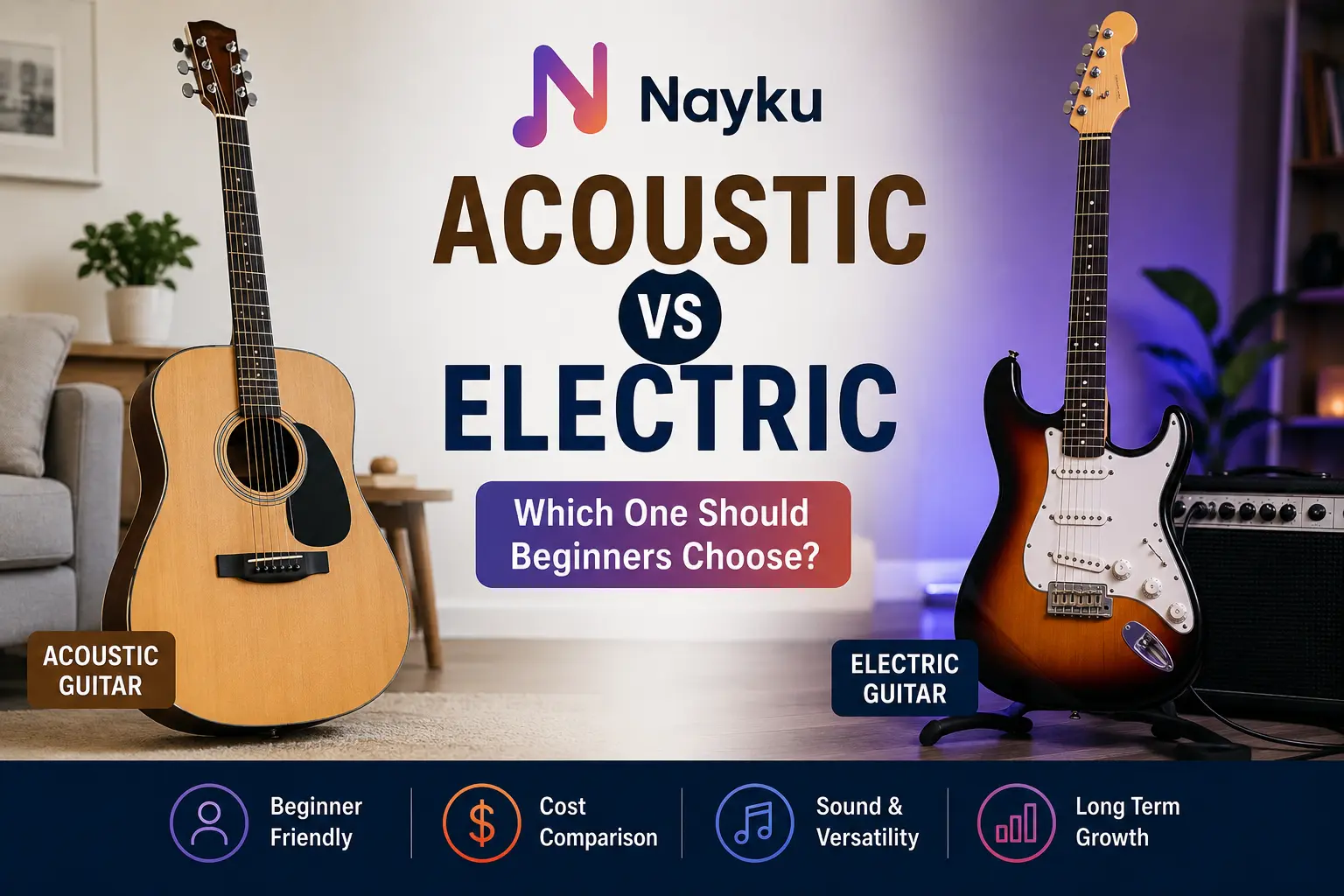
Confused between an acoustic and electric guitar? Compare costs, learning curves, sound, and beginner-friendliness to choose the right guitar.
Acoustic vs Electric Guitar: Which One Should Beginners Choose?
Introduction
One of the first questions every aspiring guitarist asks is: Should I start with an acoustic guitar or an electric guitar?
It's a valid question, and the answer can significantly impact your learning experience. Many beginners spend weeks researching guitar types, watching comparison videos, and reading reviews before making a purchase. Unfortunately, this often leads to confusion rather than clarity.
The truth is that both acoustic and electric guitars are excellent instruments for beginners. Neither is inherently better than the other. The right choice depends on your musical interests, learning goals, budget, and personal preferences.
Some people believe beginners must start with an acoustic guitar because it builds finger strength. Others argue that electric guitars are easier to play and therefore better for new learners. Both perspectives contain some truth, but neither tells the complete story.
In this guide, we'll compare acoustic and electric guitars in detail, covering everything from cost and comfort to learning curves and music styles. By the end, you'll have a clear understanding of which guitar is the best fit for your musical journey.
Understanding Acoustic Guitars
An acoustic guitar produces sound naturally through its hollow wooden body. When the strings vibrate, the sound resonates inside the guitar body and projects outward through the sound hole.
Acoustic guitars are among the most recognizable musical instruments in the world and are commonly used in genres such as:
Folk
Country
Pop
Singer-songwriter music
Bluegrass
Worship music
Advantages of Acoustic Guitars
Simplicity
Acoustic guitars require no amplifier, cables, or additional equipment. You can pick up the instrument and start playing immediately.
Portability
Since there is no need for electronic equipment, acoustic guitars are highly portable and convenient for travel.
Great for Songwriting
Many songwriters prefer acoustic guitars because they provide a full sound without requiring additional gear.
Builds Finger Strength
Acoustic guitars often have slightly thicker strings and higher string tension, helping players develop finger strength.
Challenges of Acoustic Guitars
Harder on Beginner Fingers
The thicker strings can initially cause finger discomfort.
Larger Body Size
Some beginners, especially younger students, may find full-size acoustic guitars less comfortable.
Limited Sound Variety
Acoustic guitars offer fewer tonal options compared to electric guitars.
Understanding Electric Guitars
Unlike acoustic guitars, electric guitars rely on pickups and amplifiers to produce sound.
The strings vibrate over magnetic pickups, which convert those vibrations into electrical signals that are amplified through a speaker.
Electric guitars dominate genres such as:
Rock
Blues
Metal
Jazz
Alternative
Modern Pop
Advantages of Electric Guitars
Easier to Play
Electric guitars typically have lower string action and lighter strings, making them easier on beginner fingers.
More Sound Options
Players can experiment with distortion, reverb, delay, and countless other effects.
Comfortable Neck Design
Many electric guitars have thinner necks that are easier for beginners to navigate.
Lower Finger Fatigue
Because less pressure is required to press the strings, beginners often experience less discomfort.
Challenges of Electric Guitars
Additional Equipment Required
You'll typically need:
Amplifier
Cable
Picks
Guitar stand
Higher Initial Setup Cost
The guitar itself may be affordable, but accessories increase the overall investment.
More Technical Components
Beginners must learn basic amplifier and equipment management.
Key Differences Between Acoustic and Electric Guitars
Sound Production
Acoustic guitars create sound naturally.
Electric guitars require amplification for full volume.
String Feel
Acoustic strings are generally thicker and require more pressure.
Electric strings are lighter and easier to press.
Learning Environment
Acoustic guitars are ideal for casual practice anywhere.
Electric guitars excel when connected to amplifiers and effects.
Maintenance
Both require maintenance, but electric guitars have additional electronic components.
Musical Style
Acoustic guitars are commonly used in folk and singer-songwriter genres.
Electric guitars dominate rock, blues, jazz, and metal.
Which Guitar Is Easier to Learn?
This is perhaps the most common beginner question.
The answer depends on what aspect of learning you're evaluating.
Finger Comfort
Electric guitars win.
The lighter strings and lower action make playing easier on your fingertips.
Finger Strength Development
Acoustic guitars win.
The increased resistance helps develop hand strength more quickly.
Chord Learning
Electric guitars generally feel easier for beginners.
Complex chord shapes require less pressure.
Overall Learning Experience
Many instructors agree that electric guitars provide a slightly easier introduction to playing.
However, easier does not necessarily mean better.
The best guitar is the one that motivates you to practice consistently.
Cost Comparison for Beginners
Budget is often a major factor when choosing a first guitar.
Beginner Acoustic Setup
Typical costs include:
Guitar
Gig bag
Tuner
Picks
The total setup is often more affordable.
Beginner Electric Setup
Typical costs include:
Guitar
Amplifier
Cable
Tuner
Picks
The additional equipment usually increases the total investment.
Long-Term Value
Both instruments offer excellent value.
Choose based on your musical goals rather than solely on price.
Which Guitar Is Best for Kids?
Children often benefit from instruments that feel comfortable and manageable.
Acoustic Guitar for Kids
Advantages:
Simple setup
No electronics
Encourages disciplined technique
Challenges:
Higher string tension
Larger body size
Electric Guitar for Kids
Advantages:
Easier finger pressure
Smaller body options available
Fun sounds and effects
Challenges:
Requires amplifier
Many young learners enjoy electric guitars because they are easier to play and often more exciting.
Which Guitar Is Best for Adults?
Adults typically have different motivations than younger students.
Many adults learn guitar to:
Relieve stress
Develop a hobby
Play favorite songs
Explore creativity
If you enjoy acoustic singer-songwriter music, start with an acoustic guitar.
If you're inspired by rock bands or guitar solos, choose an electric guitar.
Motivation is one of the strongest predictors of success.
Matching the Guitar to Your Favorite Music
One of the easiest ways to choose is by looking at the music you love.
Choose Acoustic Guitar If You Enjoy
Ed Sheeran
John Denver
Taylor Swift (acoustic performances)
Folk music
Country music
Choose Electric Guitar If You Enjoy
Led Zeppelin
Metallica
John Mayer
Eric Clapton
Modern rock bands
Learning becomes much more enjoyable when your instrument matches your musical interests.
Common Mistakes Beginners Make When Buying a Guitar
Buying the Cheapest Guitar Available
Poor-quality instruments often create frustration.
Choosing Based on Appearance Alone
Looks matter less than comfort and playability.
Ignoring Guitar Size
A properly sized instrument improves learning.
Buying Without Trying
Whenever possible, hold and test guitars before purchasing.
Following Generic Advice
Your goals should determine your choice.
Recommended Beginner Guitar Setup
Acoustic Guitar Setup
Beginner acoustic guitar
Clip-on tuner
Picks
Gig bag
Guitar stand
Electric Guitar Setup
Beginner electric guitar
Small practice amplifier
Instrument cable
Picks
Tuner
Guitar stand
A proper setup makes practice easier and more enjoyable.
Can You Switch Later?
Absolutely.
Many musicians eventually own both acoustic and electric guitars.
The skills learned on one instrument transfer easily to the other.
Chord shapes, scales, rhythm patterns, and music theory remain largely the same.
Starting with one type does not limit your future options.
Why Online Guitar Lessons Matter
Choosing the right guitar is important, but your learning method matters even more.
A qualified instructor can:
Help you choose the right instrument
Teach proper technique
Prevent bad habits
Create a personalized learning plan
Keep you motivated
Students who receive structured guidance often progress much faster than those who rely solely on self-teaching.
Learn Guitar Online with Nayku
At Nayku, we help students of all ages begin their musical journey with confidence.
Whether you choose an acoustic guitar or an electric guitar, our experienced instructors provide personalized lessons tailored to your goals.
Our online guitar classes are designed for:
Complete beginners
Children
Teenagers
Adults
Intermediate players
Students receive structured instruction, flexible scheduling, and ongoing support to ensure steady progress.
No matter which guitar you choose, the most important step is getting started.
Final Verdict: Acoustic or Electric Guitar?
So, which guitar should beginners choose?
Choose an acoustic guitar if:
You love singer-songwriter music.
You want a simple setup.
You prefer portability.
You enjoy folk, country, or acoustic pop.
Choose an electric guitar if:
You love rock, blues, or metal.
You want an easier playing experience.
You enjoy experimenting with sound.
You want faster finger comfort.
There is no wrong choice.
The best beginner guitar is the one that inspires you to pick it up every day.
With consistent practice, proper guidance, and a passion for music, either instrument can become the start of an incredible musical journey.
Frequently Asked Questions
1. Is acoustic guitar harder than electric guitar?
Generally, yes. Acoustic guitars usually have thicker strings and higher string tension, making them slightly harder on beginner fingers.
2. Which guitar is better for beginners?
Both are excellent choices. The best option depends on your musical interests and goals.
3. Can I start learning on an electric guitar?
Absolutely. Many successful musicians began with electric guitars.
4. Do electric guitars require an amplifier?
Yes. While you can practice quietly without one, an amplifier is needed to hear the guitar properly.
5. Which guitar hurts fingers less?
Electric guitars typically hurt less because they use lighter strings and lower action.
6. Is an acoustic guitar cheaper than an electric guitar?
Usually, yes. Acoustic guitars require fewer accessories.
7. Which guitar is better for children?
Electric guitars are often easier for children because they require less finger pressure.
8. Can I switch from acoustic to electric later?
Yes. Most skills transfer easily between both instruments.
9. How much should a beginner spend on a guitar?
A quality beginner setup is usually more important than buying an expensive instrument.
10. Which guitar should I choose if I want to play rock music?
An electric guitar is generally the best choice for rock music.
Ready to Take the Next Step?
Connect with verified experts across 50+ service categories and get things done — fast.