

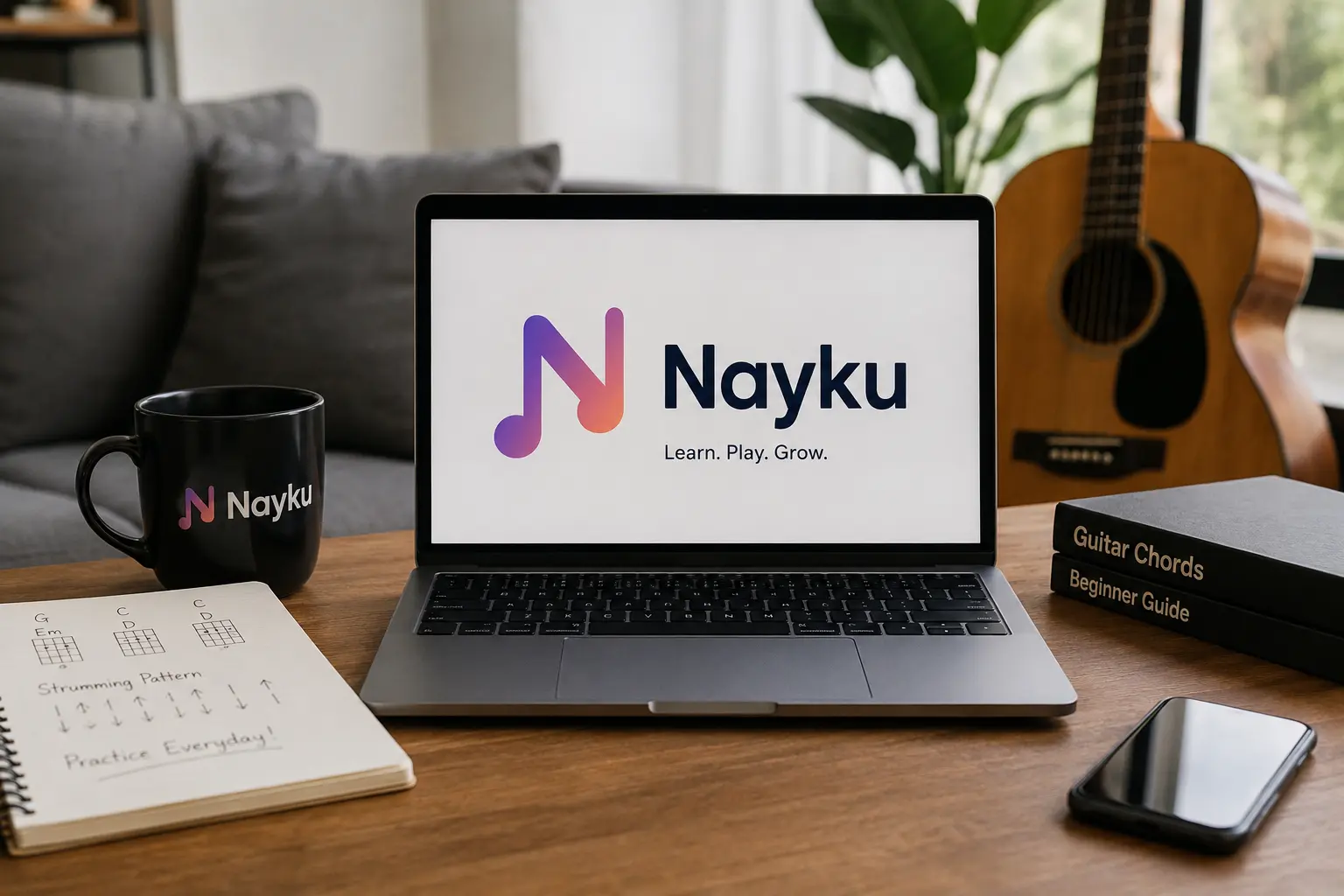
Learn guitar online with a step-by-step beginner roadmap. Discover essential chords, practice routines, common mistakes, and expert tips from Nayku.
How to Learn Guitar Online: A Complete Beginner's Roadmap
Learning guitar is one of the most rewarding skills you can develop. Whether you dream of playing your favorite songs, performing for friends and family, writing your own music, or simply picking up a creative hobby, the guitar offers endless opportunities for growth and enjoyment.
The good news is that learning guitar has never been easier. Thanks to modern technology, aspiring musicians across the United States can access professional instruction, interactive learning resources, and personalized guidance without ever leaving home. Online guitar lessons have transformed music education, making it possible for beginners of all ages to learn at their own pace and schedule.
However, many beginners struggle because they lack a clear roadmap. They spend hours watching random videos, switching between tutorials, and practicing without a structured plan. This often leads to frustration and slow progress.
If you're wondering how to learn guitar online effectively, this beginner's guide will walk you through every stage of the process—from choosing your first guitar to developing a practice routine that produces real results.
Why Learn Guitar Online?
Online guitar learning has become increasingly popular because it offers flexibility, affordability, and accessibility.
Traditional music lessons often require commuting, fixed schedules, and higher costs. Online lessons eliminate many of these challenges while providing access to experienced instructors from anywhere in the country.
Some benefits of learning guitar online include:
Flexible scheduling
Personalized instruction
Access to expert teachers
Recorded lessons for review
Comfortable learning environment
Cost-effective learning options
Whether you're a busy professional, a student, or a parent looking for lessons for your child, online learning makes it easier to fit music education into your lifestyle.
Step 1: Define Your Guitar Goals
Before you start learning, take a moment to think about why you want to play guitar.
Your goals will shape your learning journey.
Ask yourself:
Do I want to play popular songs?
Am I interested in songwriting?
Do I want to accompany my singing?
Do I hope to perform on stage someday?
Am I learning purely for enjoyment?
When your goals are clear, it becomes easier to choose the right learning path and stay motivated.
For example, someone who wants to play acoustic songs around a campfire may need a different approach than someone who dreams of playing electric guitar solos in a rock band.
Step 2: Choose the Right Guitar
One of the first decisions beginners face is choosing between an acoustic and electric guitar.
Acoustic Guitar
Acoustic guitars are often recommended for beginners because they are simple to use and require minimal equipment.
Advantages include:
No amplifier required
Portable and easy to maintain
Great for singer-songwriters
Suitable for folk, country, and pop music
Electric Guitar
Electric guitars are often easier on the fingers because they typically have lighter strings and lower action.
Advantages include:
Easier string pressure
Comfortable for beginners
Wide variety of sounds
Ideal for rock, blues, and modern genres
The best guitar is the one that motivates you to practice. Choose an instrument that aligns with your musical interests rather than following generic recommendations.
Step 3: Understand the Parts of the Guitar
Learning basic guitar terminology will help you follow lessons more effectively.
Important parts include:
Headstock
Located at the top of the guitar and houses the tuning pegs.
Tuning Machines
Used to adjust the pitch of the strings.
Neck
The long section connecting the body and headstock.
Fretboard
The surface where your fingers press the strings.
Frets
Metal strips that divide notes along the neck.
Bridge
Anchors the strings to the guitar body.
Sound Hole
Found on acoustic guitars and helps amplify sound naturally.
Understanding these components will make communication with instructors much easier.
Step 4: Learn Proper Playing Technique
Technique is one of the most important aspects of learning guitar.
Poor habits developed early can become difficult to correct later.
Proper Posture
Sit upright and keep your shoulders relaxed.
Avoid hunching over the instrument.
Fretting Hand Position
Use your fingertips to press the strings.
Keep your thumb behind the neck for support.
Picking Hand Position
Maintain a relaxed wrist and avoid excessive tension.
Finger Independence
Practice moving fingers independently to improve dexterity and control.
Good technique improves accuracy, comfort, and long-term progress.
Step 5: Learn Essential Beginner Chords
Chords are the foundation of countless songs.
Beginners should focus on a small group of essential chords before moving to advanced material.
Start with:
G Major
C Major
D Major
E Major
A Major
E Minor
A Minor
These chords appear in thousands of popular songs.
Instead of rushing to learn dozens of chords, spend time practicing smooth transitions between a few essential shapes.
Step 6: Build a Consistent Practice Routine
Consistency is the key to improvement.
Many beginners believe they need to practice for hours every day. In reality, short and focused practice sessions often produce better results.
A simple beginner routine might look like this:
Warm-Up (5 Minutes)
Practice finger stretches and simple exercises.
Chord Practice (10 Minutes)
Review known chords and practice switching between them.
Strumming Practice (5 Minutes)
Work on rhythm patterns and timing.
Song Practice (10 Minutes)
Apply your skills to actual music.
Practicing for 30 minutes daily is often more effective than practicing for three hours once a week.
Step 7: Learn Basic Strumming Patterns
Rhythm is the heartbeat of music.
Many beginners focus entirely on chords while neglecting strumming technique.
Start with simple patterns such as:
Down Down Down Down
Down Up Down Up
Down Down Up Up Down Up
Use a metronome to maintain steady timing.
As your confidence grows, experiment with different rhythms and dynamics.
Step 8: Learn to Tune Your Guitar
A guitar that is out of tune will sound unpleasant no matter how well you play.
Standard tuning from lowest string to highest string is:
E – A – D – G – B – E
Most beginners use:
Clip-on tuners
Smartphone tuning apps
Online tuning tools
Make tuning a daily habit before every practice session.
Developing your ear for pitch will help you become a better musician.
Step 9: Understand Basic Music Theory
Music theory helps you understand why music works.
You don't need advanced knowledge as a beginner, but understanding a few concepts can accelerate your progress.
Notes
The musical alphabet consists of:
A, B, C, D, E, F, and G.
Chords
Multiple notes played together.
Rhythm
The timing and pulse of music.
Scales
A series of notes used to create melodies and solos.
Learning theory alongside practical playing creates a stronger musical foundation.
Step 10: Start Playing Songs
One of the biggest mistakes beginners make is waiting too long before playing actual songs.
Songs make practice enjoyable and provide measurable progress.
Look for beginner-friendly songs that use:
G Major
C Major
D Major
E Minor
Playing recognizable music helps reinforce chords, rhythm, and timing while keeping motivation high.
Essential Guitar Equipment for Beginners
Besides a guitar, a few accessories can significantly improve your learning experience.
Guitar Tuner
Helps keep your instrument in tune.
Picks
Available in various thicknesses.
Guitar Stand
Protects your instrument and keeps it accessible.
Capo
Allows you to play songs in different keys.
Metronome
Improves rhythm and timing.
Gig Bag
Protects your guitar during transport.
These accessories are inexpensive but incredibly useful.
Best Online Tools for Learning Guitar
Modern technology offers numerous resources that support guitar education.
Helpful tools include:
Metronome Apps
Improve rhythm accuracy.
Chord Libraries
Provide visual chord diagrams.
Backing Tracks
Allow you to practice with accompaniment.
Practice Journals
Help track progress and goals.
Recording Apps
Enable self-assessment and improvement.
Combining professional lessons with these tools creates a highly effective learning environment.
Common Mistakes Beginners Make
Practicing Inconsistently
Irregular practice slows progress dramatically.
Ignoring Rhythm
Timing is just as important as playing correct notes.
Playing Too Fast
Focus on accuracy before increasing speed.
Skipping Fundamentals
Strong foundations lead to long-term success.
Comparing Yourself to Others
Every guitarist learns at a different pace.
Avoiding these mistakes can save months of frustration.
How Long Does It Take to Learn Guitar?
Learning speed varies depending on practice frequency, instruction quality, and personal goals.
After One Month
Basic chord knowledge
Improved finger strength
After Three Months
Multiple songs
Better rhythm control
After Six Months
Increased confidence
Expanded repertoire
After One Year
Strong foundational skills
Ability to learn songs independently
Remember that progress is not always linear. Consistency matters more than natural talent.
Staying Motivated Throughout Your Guitar Journey
Motivation naturally rises and falls.
To stay committed:
Set achievable goals
Track progress weekly
Learn songs you enjoy
Celebrate small victories
Record yourself regularly
Take structured lessons
Small improvements accumulate over time and eventually lead to significant progress.
Why Structured Online Guitar Lessons Matter
While self-learning is possible, professional guidance often accelerates improvement.
An experienced instructor can:
Correct mistakes early
Create personalized lesson plans
Provide accountability
Recommend appropriate exercises
Keep students motivated
Structured learning helps students progress faster and with greater confidence.
Learn Guitar Online with Nayku
At Nayku, we believe music education should be engaging, accessible, and personalized.
Our online guitar programs are designed for:
Children
Teenagers
Adults
Complete beginners
Intermediate players
Students receive individualized attention, flexible scheduling, and guidance from experienced instructors who understand how to help beginners succeed.
Whether your goal is to learn your favorite songs, develop musical skills, or pursue a lifelong passion, Nayku provides the support needed to help you grow as a guitarist.
Conclusion
Learning guitar online is one of the most rewarding investments you can make in yourself. With the right instrument, consistent practice, quality resources, and professional guidance, anyone can develop meaningful guitar skills from home.
The key is to start simple, stay consistent, and focus on steady progress rather than perfection.
Every accomplished guitarist once struggled with their first chord. The difference is that they kept practicing.
Your guitar journey begins with a single step. Start today, stay committed, and enjoy every stage of the learning process.
Frequently Asked Questions
1. Can I learn guitar online as a complete beginner?
Yes. Online guitar lessons are designed for beginners and provide structured guidance to help students learn effectively.
2. How long should I practice guitar every day?
Most beginners benefit from 20 to 30 minutes of focused daily practice.
3. Is learning guitar online as effective as in-person lessons?
Yes. With a qualified instructor and consistent practice, online lessons can be just as effective.
4. Should beginners start with an acoustic or electric guitar?
Choose the guitar that matches your musical interests and preferred genre.
5. What is the easiest guitar chord for beginners?
E Minor is often considered one of the easiest beginner chords.
6. How long does it take to learn guitar?
Most students can play simple songs within one to three months of regular practice.
7. Do I need expensive equipment to start?
No. A quality beginner guitar and a tuner are enough to begin learning.
8. Can adults learn guitar successfully?
Absolutely. Adults of all ages can learn guitar and make significant progress.
9. What are the best online tools for guitar learning?
Metronome apps, chord libraries, backing tracks, and recording apps are highly beneficial.
10. Why should I choose structured guitar lessons?
Structured lessons provide expert feedback, accountability, and a clear learning path that accelerates progress.
Ready to Take the Next Step?
Connect with verified experts across 50+ service categories and get things done — fast.