

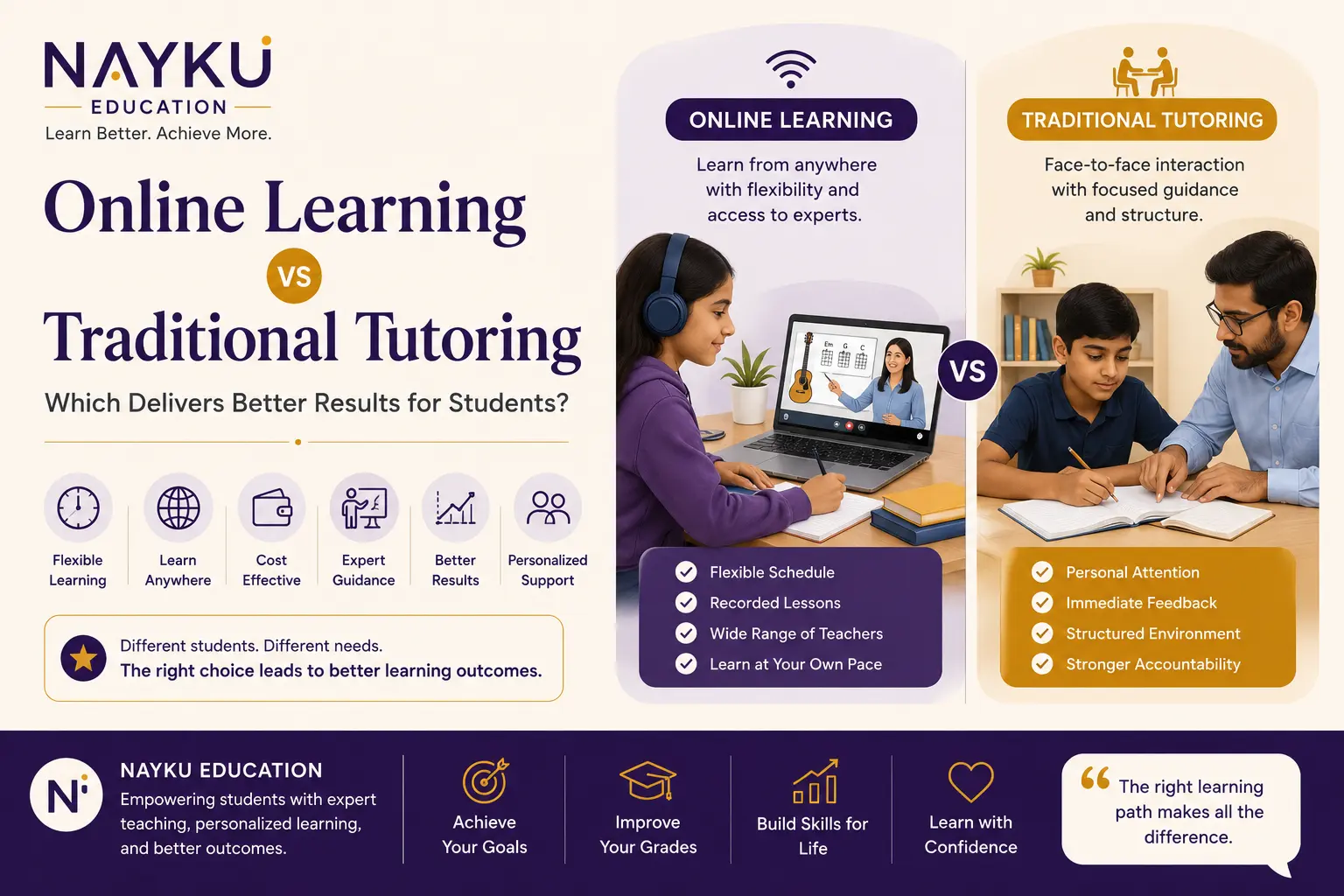
Compare online learning and traditional tutoring to discover which method delivers better academic results. Learn the advantages, challenges, costs, flexibility, and how Nayku Education supports student success.
Online Learning vs Traditional Tutoring: Which Delivers Better Results for Students in 2026?
Introduction
Education has evolved dramatically over the last decade. Technology has transformed how students access knowledge, interact with teachers, and develop new skills. What once required a physical classroom can now be accomplished from virtually anywhere through online learning platforms.
At the same time, traditional tutoring remains a trusted method for academic improvement. Many parents continue to prefer face-to-face instruction because of its personal interaction and structured environment.
This raises an important question: Which delivers better results for students—online learning or traditional tutoring?
The answer is not as simple as choosing one over the other. Both approaches offer unique benefits and challenges. The most effective solution often depends on the student's learning style, goals, schedule, and level of support.
At Nayku Education, we work with students across different age groups and learning needs. Through our experience, we have seen how both methods can be successful when implemented correctly.
This guide explores the differences between online learning and traditional tutoring, helping students and parents make informed decisions.
Understanding Online Learning
Online learning refers to educational instruction delivered through digital platforms.
Students typically learn through:
- Live virtual classes
- Recorded lessons
- Interactive assignments
- Digital assessments
- Online discussions
- Educational platforms
Online learning has become increasingly popular because it provides flexibility and accessibility without geographical limitations.
Understanding Traditional Tutoring
Traditional tutoring involves face-to-face instruction between a teacher and student.
Sessions may occur:
- At tutoring centers
- At home
- In schools
- At educational institutes
Traditional tutoring provides direct interaction and immediate feedback within a physical learning environment.
Why This Comparison Matters More Than Ever
Students today face:
- Increased academic competition
- Busy schedules
- Multiple extracurricular activities
- Greater access to educational resources
Parents want educational solutions that:
- Improve grades
- Build confidence
- Encourage independent learning
- Fit into modern lifestyles
Choosing the right learning format can significantly impact student performance.
Benefits of Online Learning
1. Flexibility and Convenience
One of the greatest advantages of online learning is flexibility.
Students can:
- Learn from home
- Avoid travel time
- Attend classes from anywhere
- Schedule lessons around school and activities
This convenience often leads to better consistency.
2. Access to Expert Educators
Traditional tutoring limits students to local instructors.
Online learning removes geographical barriers.
Students gain access to:
- Specialized teachers
- Experienced instructors
- Subject experts
- International educators
This wider pool of expertise can improve learning outcomes.
3. Personalized Learning Pace
Every student learns differently.
Some students grasp concepts quickly, while others need more time.
Online learning allows students to:
- Review lessons repeatedly
- Pause and revisit concepts
- Progress at their own pace
- Focus on weak areas
This personalized approach can improve understanding.
4. Recorded Sessions for Revision
A major advantage of online learning is lesson recordings.
Students can:
- Rewatch difficult topics
- Prepare for exams
- Review teacher explanations
- Reinforce concepts
Traditional tutoring typically lacks this feature.
5. Cost-Effective Education
Online learning often reduces costs associated with:
- Transportation
- Facility expenses
- Printed materials
Many families find online education more affordable while maintaining quality instruction.
6. Digital Skill Development
Online learning naturally improves:
- Technology literacy
- Digital communication
- Self-management
- Independent research
These skills are increasingly valuable in modern education and careers.
Benefits of Traditional Tutoring
1. Face-to-Face Interaction
Many students benefit from direct personal interaction.
Teachers can:
- Observe body language
- Identify confusion immediately
- Provide hands-on assistance
- Build stronger rapport
This interaction can enhance engagement.
2. Fewer Digital Distractions
Online learning requires discipline.
Traditional tutoring often reduces distractions from:
- Social media
- Mobile phones
- Gaming
- Online browsing
The physical classroom environment promotes focus.
3. Immediate Physical Guidance
Subjects requiring demonstrations sometimes benefit from in-person instruction.
Examples include:
- Science experiments
- Art activities
- Hands-on projects
Physical presence allows direct assistance.
4. Structured Learning Environment
Traditional tutoring provides a dedicated academic setting.
This structure can help students who struggle with:
- Time management
- Self-discipline
- Independent study
Challenges of Online Learning
Despite its advantages, online learning presents certain challenges.
Self-Discipline Requirements
Students must manage their own learning habits.
Without discipline, progress may slow.
Technical Issues
Challenges can include:
- Internet interruptions
- Device problems
- Software difficulties
Reliable technology is essential.
Reduced Social Interaction
Online environments may offer fewer opportunities for casual social engagement compared to physical classrooms.
Home Distractions
Learning from home can sometimes reduce concentration if a dedicated study space is unavailable.
Challenges of Traditional Tutoring
Traditional tutoring also has limitations.
Travel Requirements
Students must commute to sessions.
This can:
- Increase costs
- Consume time
- Create scheduling conflicts
Limited Teacher Availability
Students are restricted to local educators.
Specialized expertise may not always be available nearby.
Higher Costs
Traditional tutoring often includes:
- Facility costs
- Transportation expenses
- Additional fees
These factors may increase overall costs.
Fixed Scheduling
Traditional sessions typically operate on strict schedules.
Rescheduling can be difficult.
Comparing Learning Outcomes
Academic Performance
Research consistently shows that motivated students can achieve strong results through both methods.
Success depends more on:
- Quality instruction
- Consistency
- Student engagement
- Practice habits
than the delivery format itself.
Student Engagement
Online learning can be highly engaging when lessons include:
- Interactive activities
- Visual resources
- Discussions
- Assessments
Traditional tutoring relies more heavily on direct teacher interaction.
Knowledge Retention
Students often retain information better when they:
- Review material regularly
- Practice actively
- Receive feedback
Online learning offers recorded lessons, while traditional tutoring provides live reinforcement.
Which Students Benefit Most from Online Learning?
Online learning is ideal for students who:
- Have busy schedules
- Are comfortable with technology
- Prefer flexible learning
- Need access to specialized instruction
- Learn independently
These students often thrive in digital learning environments.
Which Students Benefit Most from Traditional Tutoring?
Traditional tutoring may be preferable for students who:
- Need constant supervision
- Struggle with self-discipline
- Prefer face-to-face interaction
- Benefit from structured routines
Learning preferences play a significant role.
The Rise of Hybrid Learning
Many educators now believe the future lies in hybrid learning.
Hybrid models combine:
- Online flexibility
- Personalized instruction
- Direct interaction
- Digital resources
This balanced approach often delivers excellent results.
How Parents Can Choose the Right Option
Before selecting a learning format, consider:
Learning Style
Does the student prefer independent learning or direct supervision?
Schedule
Is flexibility important?
Academic Goals
What outcomes are being targeted?
Budget
Which option fits the family's financial plan?
Technology Access
Does the student have reliable devices and internet?
The best solution is the one that supports consistent learning.
How Nayku Education Supports Student Success
At Nayku Education, we recognize that every student learns differently.
Our programs focus on:
Personalized Learning Plans
Instruction tailored to individual needs.
Flexible Online Classes
Students can learn from anywhere.
Experienced Educators
Qualified instructors guide students step by step.
Progress Tracking
Regular feedback helps students improve.
Interactive Learning
Engaging lessons encourage participation.
Confidence Building
Students develop academic skills while gaining self-confidence.
Our goal is not simply to improve grades but to help students become lifelong learners.
Conclusion
So, which delivers better results: online learning or traditional tutoring?
The truth is that both can be highly effective when supported by quality instruction, student commitment, and consistent practice.
Online learning offers flexibility, accessibility, affordability, and personalized pacing. Traditional tutoring provides face-to-face interaction, structured environments, and direct support.
Rather than asking which method is universally better, parents and students should focus on which approach best matches their individual needs and goals.
At Nayku Education, we believe successful learning happens when students receive the right guidance, the right resources, and the confidence to grow.
Frequently Asked Questions
1. What is the difference between online learning and traditional tutoring?
Online learning uses digital platforms, while traditional tutoring takes place in person.
2. Is online learning as effective as traditional tutoring?
Yes, when supported by quality instruction and consistent effort.
3. Which option is more affordable?
Online learning is often more cost-effective.
4. Can online learning improve grades?
Yes, especially when students follow structured programs.
5. Is online learning suitable for younger students?
Yes, with proper guidance and parental support.
6. Do students learn faster online?
Learning speed depends on the student and instructional quality.
7. What are the biggest advantages of online learning?
Flexibility, accessibility, affordability, and recorded lessons.
8. What are the benefits of traditional tutoring?
Face-to-face interaction, structure, and direct supervision.
9. Can online classes be interactive?
Yes, modern platforms support highly interactive learning experiences.
10. What equipment is needed for online learning?
A device, internet connection, and learning platform access.
11. How do parents choose the right option?
Consider learning style, goals, schedule, and budget.
12. Is hybrid learning effective?
Yes, it combines the strengths of both approaches.
13. Can online learning replace tutoring completely?
For some students, yes. Others may benefit from additional support.
14. Why is personalized learning important?
It allows instruction to match a student's specific needs.
15. How does Nayku Education support learners?
Through personalized instruction, flexible classes, progress tracking, and expert guidance.
Ready to Take the Next Step?
Connect with verified experts across 50+ service categories and get things done — fast.